
This audit covers my interviews, my posting, my resume, my network. One piece worth checking on your own: whether recruiters can find your profile at all. About two minutes. Your first fix is free.
Check your findability→In early 2025 I started posting on LinkedIn seriously, with a real strategy behind it. It was working. Then in April I took a new job, told myself I'd keep it going, and within a couple of months I'd fallen off completely.
That decision didn't cost me anything for a while. It cost me plenty this January, when I suddenly needed the engine again and had to rebuild it from scratch, mid-search, at the worst possible time.
My search is over now. I signed, I start soon, and before I close this chapter I did what I apparently can't stop doing with anything in my life: I put the whole thing in a spreadsheet and audited it like a funnel. Every process, where it started, how far it got, how it ended.
I've been doing this throughout the process to basically find the problem and solve it, but spoiler alert, there was no major problem. It's just that this job market is tough. There are things I could have done better, and I do have learnings, but overall, all that would have done is give me more high-quality lotto tickets (and maybe let me spend less time on waste-of-time interview processes and put that time toward something else), but there was no gaping hole.
My advance rate sat close to 50% at each stage, as an average. It improved a lot over time too.
What warm intros actually did for me
Warm opportunities (inbound leads, intros through my network, people who found me) turned into real interviews about 3x more often than my cold applications did.
Once I was inside a process, though, warm and cold advanced at nearly the same rate. Close to 50% at each stage either way.
I don't think that means intros don't matter. They clearly do. They make it meaningfully easier to reach a hiring manager in the first place, and that first step is the hardest one in the whole funnel. But past that step, it's on your performance. The one exception is when someone already knows you and is hiring you directly, and that's a different situation entirely.
So get the intros. Just know what they're buying you: the conversation. What happens after that is on you.
Same number of interviews every month. Very different results.
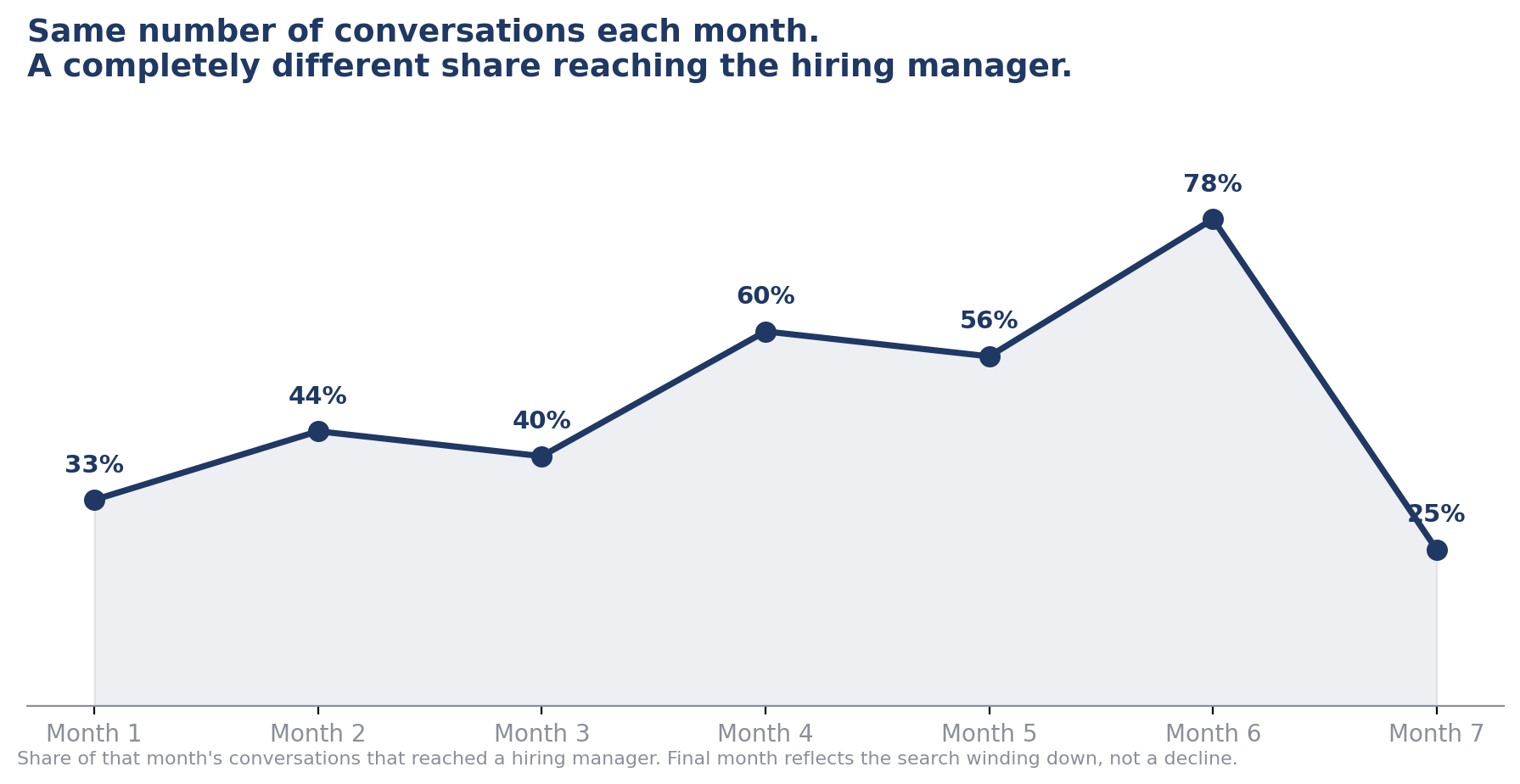
This chart is my favorite thing to come out of the audit.
My monthly interview count barely changed across the search. But early on, about a third of my interviews reached a hiring manager. By the end, it was closer to four out of five.
I wasn't working harder in month six than in month two. I promise you that.
What changed was what I let into the funnel. Early on I said yes to almost everything: cold applications to so-so fits, recruiter calls for roles that were never right. Later I was pickier about what I pursued, and more of what came to me was already right before we ever talked.
This is the same lesson I keep writing about on the marketing side of this site. When a business is struggling, the instinct is to send more email. When a search is struggling, the instinct is to apply to more jobs. Same instinct, same trap. More of a thing that isn't working just gets you more of what you already have. The fix is changing the strategy, not the volume.
The rebuild took longer than the restart
Back to that April 2025 mistake, because the shape of the cost surprised me.
When I picked posting back up this January, the engagement came back almost immediately. That part was fast, and honestly encouraging.
But engagement isn't the engine. The engine is the right people knowing what you're about and sending you real opportunities, and that part took months to rebuild. The early inbound was broad and low-fit, and I spent too much time on it before I got picky. It took a few months before the leads coming in were the kind worth taking.
Here's the part I only understood after analyzing my own old posts: the ones I did write while employed performed badly, and the reason is almost embarrassing. I sounded employed. Launch announcements. Team stuff. Nobody cares about your launch. Nobody cares that your team did something cool. Nobody. Ever. At least not on the surface, you have to bring it back to being a relatable human being, not corporate speak.
Resumes and cover letters, from someone who's been on both sides
This one might be unpopular.
I don't believe tailoring your resume for every single application is what drives interview volume. It might get you a job. But that's closer to luck than a strategy that scales, and it eats hours you could spend on things that actually move the needle.
I had one main resume for most of the search. Occasionally three or four versions for genuinely different role types. I'm not against variation. I'm against per-application tailoring as the lever.
Cover letters? I rarely wrote them this entire search. I don't think almost anybody reads them.
And I say all this as a hiring manager myself. When I'm screening candidates, I look at the resume, the titles, a couple of quick things, and then I go straight to LinkedIn. That's where I actually form an opinion. Which tells you where your time should go.
Network smarter, not harder
The most useful networking I did wasn't cold outreach. I used LinkedIn itself: I looked at who was engaging with my posts, viewing my profile, and following me, and I expanded my network very thoughtfully from there.
People who comment on your posts, people who just followed you, people who viewed your profile. They're already in the zone. They already know who you are. Reaching out to them converts because the ice is pre-broken. (One of the most valuable things LinkedIn Premium gave me was simply seeing who's viewing me, and I'd also look at who is following me, so I could reach out to the interesting ones.)
I did some proactive outreach to contacts at companies I found interesting, and that's worth doing too. But most of my networking was organic, and organic worked better.
What I'd actually do differently
Here's the money section:
- I would never have stopped posting. That's the big one. If I'd kept going after April 2025, this January wouldn't have been a cold start, and the engine would have been sending me good leads from week one instead of month four. You want to be building this all the time, while you're employed and nothing is on fire. I've written the full case for this.
- I'd sound like a person the whole time, not an employee. My employed-era posts were company news, not Julie news, and they went nowhere. The stuff that works is what YOU think, what you'd teach someone, what you've figured out. That doesn't stop being available just because you have a job. (I'll be honest, I haven't fully figured out what this looks like for my next chapter either. More on that as I live it.)
- I'd nail down my positioning sooner, and say it everywhere. Mine ended up being: consumer and patient focused marketing director who figures out why people aren't engaging before spending budget or picking channels, then builds the strategy that fixes it. Was it a perfect box? No. I landed outside healthcare this round, and I was never rigidly committed to healthcare anyway; it's just where I focused most of my energy. But here's why the box matters: people can't refer you to something if they don't know what you're looking for. And that's not just your close contacts. It's anyone in your network, including someone you haven't talked to in years. You can only have so many 1:1 conversations. LinkedIn is how your positioning reaches everyone at once.
- I'd get discerning way earlier, on both inbound and outbound. If a role isn't a real fit, it's not worth the time, even when it sounds interesting. Part of being discerning is knowing when you're not the realistic pick: if another candidate has closer, more direct experience, they're getting that job, and your hours are better spent elsewhere. I found this filter months later than I should have. I don't think finding it sooner would have gotten me hired faster. But it would have given me back real time.
- I'd spend project time on substance, not production. I did five take-home projects this search. I overspent badly on the first three, partly because these projects had paid off for me historically (all but one time, a project like this got me the job), so I assumed the same payoff this cycle. Twenty hours on one of them, doing what was honestly $$$ of free strategy work, guessing at what they wanted with zero feedback along the way. By the last two I'd learned to scope them reasonably. My regret isn't doing them. I think they're sometimes genuinely useful, though I also think they're overused industry-wide. My regret is the allocation: too much time on deck design and polish that added almost nothing. Put the time into the thinking. For the deck itself, if you don't have a template or an AI tool you can plug into, don't hand-build one. Get a Gamma subscription, pay the $10, and let it make things look professional. It doesn't have to be in their brand and it doesn't have to wow anyone. The thinking is the deliverable.
- I'd optimize my profile on day one, not month three. Recruiters aren't searching for you the way you may think. You need to optimize your profile. I built an artifact that helps you do this, and it went mini-viral, so I built it into a real product. And I'm not trying to pitch-sell you here: whatever you use, mine or anything else, do it. Though honestly, my take after all of this is that posting consistently and clear positioning matter more than anything else in the process, including profile optimization. The profile is the floor. The posting is the engine.
Where this leaves me
The market is brutal right now, and I've written plenty about that side of it. I believe I executed well anyway, and the audit backs that up. And here's the thing that makes all of this worth writing down: if I had to start from zero today, I think it would take less time. Not because the market got easier. Because the foundation is already built, and this time I'm not letting it go quiet.
This is the last of my job search postmortem content for now. Next up: actually succeeding in the new role, moving into a new industry, and what I've learned from a career where every title was different but the work was always the same thread. I'll still write about the job market sometimes, because I know a lot of you are still in it and I haven't forgotten what it feels like. But it's time to write from the other side.